
"Hey Google, can I park here?”
Volvo Cars and Google aim to create a new generation of contextually aware driving experiences by bringing together the best of their respective technologies, leveraging the latest advancements in AI and Google Gemini.
As part of a world first, Volvo Cars and Google will demonstrate Google Gemini vehicle camera integration in the EX60, at Google I/O conference (May 19-20). This paves the way for a future where, with the driver’s permission, Gemini will be able to see and understand its surroundings from the perspective of the car in real time.
This will enable a more helpful driving experience for things like recalling a road sign, making sense of lane markings or simply asking for more information about a landmark or a restaurant.
Take parking as an example. By reading and interpreting parking signs in real time, the system helps drivers quickly understand restrictions, time limits, permit requirements or charging rules. Instead of second-guessing whether a space is valid, drivers receive clear guidance exactly when and where they need it.
“The EX60 provides an ideal platform to explore the future of contextually aware driving experiences,” says Alwin Bakkenes, Head of Global Software Engineering at Volvo Cars. “Working closely with Google as a lead device partner allows us to help bring the latest advances in AI into the automotive environment faster and more collaboratively than ever before.”
These concepts provide an early look at how contextually aware AI experiences will in the future become part of the every-day driving experience. This is made possible by the Gemini model’s multi-modal understanding*, the EX60’s neural processing engine** and software- defined architecture.
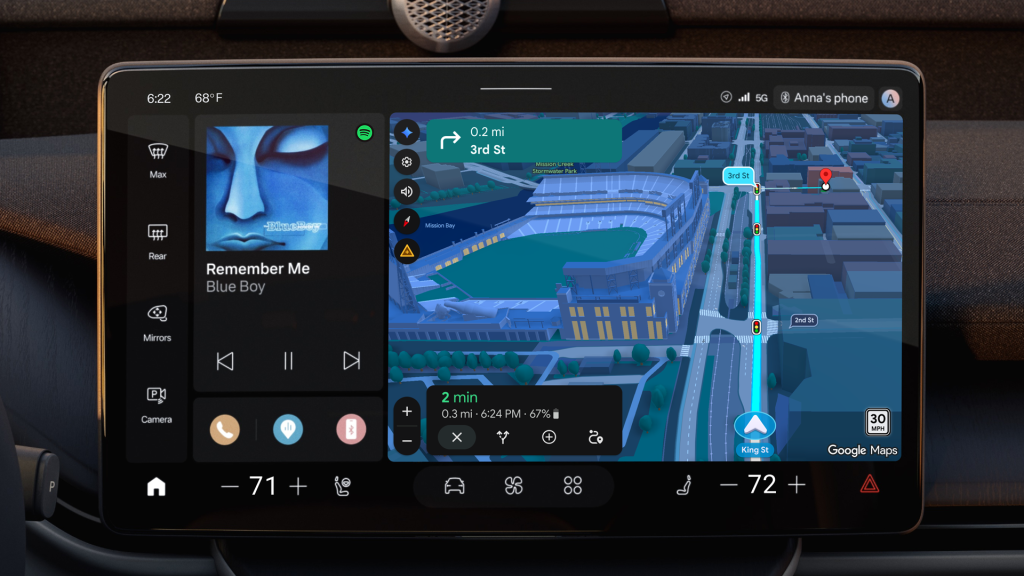
More intuitive directions with Immersive Navigation from Google Maps
Soon, Volvo Cars will also be among the first to introduce Immersive Navigation from Google Maps into its cars. With a new 3D view, Immersive Navigation offers even more intuitive guidance for drivers, helping them stay informed and focused on the road.
Drivers will see their route brought to life with redesigned buildings, tunnels, overpasses and more, making it easy to quickly understand complex roads and turns. This is particularly valuable in urban environments where skyscrapers and dense intersections can make it difficult to see the road ahead.
It also delivers more natural voice guidance with helpful instructions that call out real-world landmarks in addition to distance and timing, such as “Go past this light and take the next left after the library.” By aligning what drivers hear with what they see, navigation becomes even easier to follow.
“We’re excited to partner with Volvo Cars on helping build the next generation of driving experiences for the real world,” says Patrick Brady, Vice President of Android for Cars at Google. “In the future, Gemini will make your drive more helpful by allowing you to learn more about your surroundings while on the road. And with Immersive Navigation, we’re bringing Google Maps’ biggest update in over a decade to our drivers.”
Immersive Navigation from Google Maps will first be available in the Volvo EX60, EX90 and ES90.
These announcements reflect an ongoing relationship between Volvo Cars and Google as the two companies work together to shape the next generation of in-car intelligence.
The small print
- *Multi-modal understanding: AI’s ability to combine and interpret inputs such as voice, images, and context to understand a situation.
- ** Neural Processing Engine (NPU): A dedicated processor that runs AI tasks efficiently and in real time on-device.
- Features may differ depending on subscription, and results may vary. Google Gemini is AI and can make mistakes.Connected apps require setup and providing necessary permissions. Compatibility and availability vary. 18+.
- Google Gemini and Google Maps are trademarks of Google LLC..
About Volvo Car Group
Volvo Cars was founded in 1927. Today, it is one of the most well-known and respected car brands in the world with sales to customers in more than 100 countries. Volvo Cars is listed on the Nasdaq Stockholm exchange, where it is traded under the ticker “VOLCAR B”.
“For life. To provide freedom to move in a personal, sustainable and safe way.” This purpose is reflected in Volvo Cars’ ambition to become a fully electric car maker and in its commitment to an ongoing reduction of its carbon footprint, with the ambition to achieve net-zero greenhouse gas emissions by 2040.
In 2025, Volvo Cars sold over 710 000 cars, with an electrified share of 46%.
Volvo Cars on average employed 42,600 full-time employees. Volvo Cars’ head office, product development, marketing and administration functions are mainly located in Gothenburg, Sweden. Volvo Cars’ production plants are located in Gothenburg, Ghent (Belgium), South Carolina (US), Chengdu, Daqing and Taizhou (China). The company also has R&D and design centres in Gothenburg and Shanghai (China).