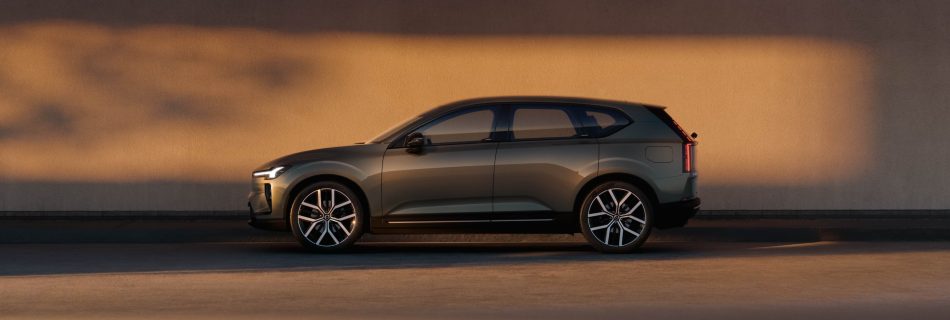
The car that changes the game – meet the new, all-electric Volvo EX60

The car that changes the game – meet the new, all-electric Volvo EX60 Say hello to the Volvo EX60 – a new, all-electric mid-size SUV that changes the game in the largest electric market segment in terms of range, charging speed, performance and price. The five-seater, family-friendly EX60 ends range anxiety, delivers a ground breaking user experience and represents the next frontier in safety. It is also Volvo Cars’ first entry in the largest electric segment globally, allowing it to substantially increase its addressable market and electric market share. “The new, all-electric EX60 changes the game in terms of range, charging and price and represents a new beginning for Volvo Cars and our customers,” says Håkan Samuelsson, CEO of Volvo Cars. “With this car, we remove all remaining obstacles for going electric. This fantastic new car is also a testament of what we are capable of at Volvo Cars, with an all-new product architecture introducing new key technologies – mega casting, cell-to-body and core computing.” The EX60 can go up to a best-in-class 810 kilometres on a single charge in an all-wheel drive configuration. This doesn’t just make it go further than any electric car that Volvo Cars has ever created. It also beats its recently revealed competitors, setting a new standard for its segment. That same no-compromises approach is reflected in how fast it charges. A quick coffee stop is enough to recharge and hit the road again. The EX60 can add up to 340km of range in just ten minutes when using a 400kW fast charger. In other words, the EX60 turns range anxiety into range comfort and demonstrates that going electric is no longer a compromise. Design, engineering, hardware and software all work together to create a car that optimises driving range and matches many petrol cars. When ordering, the new customer experience has been designed for simplicity, transparency and precision. The offer gives customers transparency on price, clarity on what content they get in the car, and a precise estimated delivery time. Customers can also pick a pre-configured car available for instant delivery, always with the option for a fully customised car that takes slightly longer to deliver. The EX60 is available with three different powertrain variants. The P12 AWD Electric variant offers the class-leading range of up to 810km, while the P10 AWD Electric clocks in at a range of up to 660km. A rear-wheel powered P6 Electric variant delivers up to 620km of range. All in all, the EX60 is available in seven attractive variants, covering all needs and lifestyles.  The EX60 comes with 10 years of battery warranty. In Sweden, the EX60 will also come with three years of free home charging. This offer applies immediately to private customers in Sweden before being rolled out into other markets. The EX60 is built on SPA3, Volvo Cars’ new electric vehicle architecture, and powered by HuginCore, the Volvo Cars core system. It sets new standards in scalability, modularity, manufacturing efficiencies and cost. Cell-to-body technology, next-generation in-house developed e-motors, a new battery cell design and mega casting all help to boost energy efficiency and driving range, while reducing weight. This also helps the EX60 to achieve the lowest carbon footprint for a fully electric Volvo car, matching that of the smaller EX30 and making the EX60 a better choice for the environment. Scandinavian design with purpose In terms of design, the EX60 takes the company’s Scandinavian design principles further into an all-electric era. It combines a stylish, confident and efficient exterior with natural, high-end materials inside that give customers a calm, refined and versatile space with smart storage. A low front, a sloping roofline and tapered body sides all boost overall aerodynamic efficiency. As a result, the EX60 slides through the air and has a very competitive drag coefficient of 0.26, contributing to the class-leading range. Inside, the EX60 is a star in versatility and practicality. The long wheelbase and flat floor create much more legroom in the rear, as well as a large luggage compartment and various smart storage spaces for personal items. For those who love music, the EX60 is an excellent choice with a premium 28-speaker Bowers & Wilkins audio system. For the first time in a Volvo car, this system also includes headrest speakers in all four main seats. The EX60 will be the first Volvo with Apple Music pre-installed with Dolby Atmos, delivering an immersive Spatial Audio experience. An intelligent car you can talk to naturallyAs Volvo Cars’ most intelligent car yet, the EX60 is packed with state-of-the-art technology designed to improve life behind the wheel. The EX60 is powered by the latest iteration of HuginCore, the Volvo Cars core system that empowers the car to think, process and act. It embodies the company’s approach to technology development, combining in-house development and collaboration with tech leaders such as Google, NVIDIA and Qualcomm Technologies Inc. The EX60 is the first Volvo car to launch with Gemini, the new AI assistant from Google. Gemini is deeply integrated with your car and lets you have natural and personalised conversations without having to remember specific commands. The introduction of Gemini reflects the longstanding relationship between Volvo Cars and Google, and Volvo Cars’ status as a lead development partner and one of the reference hardware platforms for AndroidTM Automotive OS. The EX60 also contains the most responsive user experience in any Volvo car to date. In this seamless and no-lag infotainment system, screens respond quickly, maps load instantly, voice assistants understand passengers better, and everything feels smooth, while the UX provides quicker access to key functions. One of the safest cars on the marketThis being a Volvo, it is one of the safest cars on the market and represents the purest form of the Volvo Cars Safety Standard, going above and beyond regulations and rating requirements. Enabled by HuginCore, the EX60 reaches new levels of safety, as it constantly assesses the world around the car through its wide array of sensors. The result is a car with a clear and precise …

Volvo EX90 earns five-star rating in Euro NCAP safety tests

Volvo EX90 earns five-star rating in Euro NCAP safety tests In the most recent round of Euro NCAP safety testing, the fully electric Volvo EX90 SUV earned the maximum five-star rating, placing it among the highest-performing cars this year. Euro NCAP is a leading independent car safety assessment program in Europe and helps customers make informed decisions about cars’ safety performance. The family SUV, available with up to seven seats, scored particularly high in both adult and child protection categories. “Volvo Cars has long been a pioneer in automotive safety, and the EX90 is the latest example of that leadership,” says Åsa Haglund, head of Volvo Cars Safety Centre. “It builds on more than 55 years of real-world crash research, informing how we design our cars for traffic situations people face every day – not just controlled test environments. This Euro NCAP result shows that our commitment to real-world protection translates into top performance in independent safety tests.” With crash research and data from more than 50,000 real-life accidents involving more than 80,000 people, Volvo Cars has built a deep understanding of how to help protect people. Combined with virtual and physical testing, that knowledge powers the company’s development of safety innovations. It also helps to form the foundation of the Volvo Cars Safety Standard – an in-house benchmark that goes beyond the official requirements for safety testing.   The EX90 is born smart, connected and electric. It’s packed with protective and preventive safety technology and software, powered by core computing and informed by advanced sensors. This enables the car to process real-time data, learn and adapt – and thanks to over-the-air updates, Volvo Cars can continuously improve and grow functionalities over time. The EX90 makes use of Volvo Cars’ Safe Space Technology, a bespoke suite of safety systems on each model, designed to work together to help protect people in and around the car. Using advanced sensors, cameras, and radars, the car builds an understanding of its surroundings to help anticipate and mitigate potential risks.   In the event of a crash, its state-of-the-art restraint technology and structural design, tuned specifically for the EX90 – are designed to help protect the driver and passengers. Among the EX90’s standout safety features is the driver understanding system, also available in the ES90. Named one of TIME’s Best Inventions in 2024, the system uses real-time sensing technology to detect the driver’s state and provide support when needed – for example, when a driver may be tired, distracted or otherwise not fully capable of driving. The EX90 also comes with full-cabin occupant sensing to help prevent leaving loved ones behind in potentially dangerous situations. Advanced radars can detect movements as subtle as a baby’s breathing and alert you if necessary.  This latest result adds to the growing list of honours for the EX90, which also includes the prestigious World Luxury Car title awarded earlier this year.

Volvo Cars’ multi-adaptive safety belt, debuting in the upcoming EX60, named one of TIME’s Best Inventions 2025

Volvo Cars’ Multi-Adaptive Safety Belt, Debuting In The Upcoming Ex60, Named One Of Time’s Best Inventions 2025 The world-first multi-adaptive safety belt, set to debut in Volvo Cars’ soon-to-be-revealed fully electric EX60 SUV, has been recognised as one of the Best Inventions of 2025 by TIME. Today, TIME revealed its annual list of the Best Inventions, which features 300 extraordinary innovations changing our lives. For the second year in a row, Volvo Cars is honoured to be included on the list for its latest safety innovation. The new multi-adaptive safety belt is designed to even better protect occupants by adapting to the traffic conditions and the person wearing it. “We are proud to be recognised by TIME as a leader in automotive safety,” says Åsa Haglund, head of Volvo Cars Safety Centre. “With the multi-adaptive safety belt in the upcoming EX60, we’re leveraging real-time data to adapt to the situation and the person wearing it – providing smarter, personalised protection that can help reduce injury.” Leveraging real-time data from the car’s advanced interior and exterior sensors, the system can customise protection by adjusting to the current situation and the unique personal profile of drivers and passengers, such as their height, weight, body shape and seating position. For example, a larger occupant in a severe crash will receive a higher belt load setting to help reduce the risk of head injury, while a smaller occupant in a milder crash will receive a lower belt load setting to reduce the risk of rib fractures. The capabilities of the new multi-adaptive safety belt are designed to continuously improve via over-the-air software updates. As Volvo Cars gathers more insights, the car can improve its understanding of the occupants, new scenarios and response strategies. This invention demonstrates how Volvo Cars continues leading in safety innovation to better protect people by leveraging insight from real-world data. Last year, another Volvo Cars safety feature was named one of TIME’s Best Inventions of 2024. The pioneering Driver, available in the Volvo EX90 and ES90, uses real-time sensing technology to help detect if a driver is impaired, tired or distracted, so the car can step in to provide support if needed. The new safety belt will be introduced in the upcoming Volvo EX60, which will be revealed to the world on 21 January 2026 during a livestreamed event from Stockholm, Sweden. The small printTo compile this year’s list, TIME solicited nominations from TIME editors and correspondents around the world and through an online application process, paying special attention to growing fields – such as health care, AI, and green energy. TIME then evaluated each contender on a number of key factors, including originality, efficacy, ambition, and impact. Read TIME’s Best Inventions of 2025 list here.       ——————————-  Volvo Cars in 2024 For the full year 2024, Volvo Car Group recorded a record-breaking core operating profit of SEK 27 billion. Revenue in 2024 amounted to an all-time high of SEK 400.2 billion, while global sales reached a record 763,389 cars.  About Volvo Car Group Volvo Cars was founded in 1927. Today, it is one of the most well-known and respected car brands in the world with sales to customers in more than 100 countries. Volvo Cars is listed on the Nasdaq Stockholm exchange, where it is traded under the ticker “VOLCAR B”. “For life. To give people the freedom to move in a personal, sustainable and safe way.” This purpose is reflected in Volvo Cars’ ambition to become a fully electric car maker and in its commitment to an ongoing reduction of its carbon footprint, with the ambition to achieve net-zero greenhouse gas emissions by 2040. As of December 2024, Volvo Cars employed approximately 42,600 full-time employees. Volvo Cars’ head office, product development, marketing and administration functions are mainly located in Gothenburg, Sweden. Volvo Cars’ production plants are located in Gothenburg, Ghent (Belgium), South Carolina (US), Chengdu, Daqing and Taizhou (China). The company also has R&D and design centres in Gothenburg and Shanghai (China). 

One millionth Volvo plug-in hybrid now on road

One millionth Volvo plug-in hybrid now on road Volvo Cars reached an important milestone in its electrification journey in September, as it delivered its one millionth plug-in hybrid. The company is transitioning towards becoming a fully electrified car maker, with plug-in hybrids (PHEVs) a significant pillar of the company’s growth today, as signified by this milestone. PHEVs made up 23 per cent of Volvo Cars’ global sales in the first half of 2025. PHEV sales grew from almost 46,000 units in 2019 to over 177,000 units in 2024, underpinned by strong demand for the XC60 and XC90 PHEV in all three main sales regions. The XC60 was the best-selling PHEV in Europe in 2024 and led the premium PHEV segment globally in the last three years. It continues to be a segment leader in 2025. Both the XC60 and XC90 were renewed last year, reinforcing their appeal in key markets such as Sweden, the US and China.   Thanks to the robust demand for its PHEVs, Volvo Cars has the highest share of PHEV sales of its total sales among all legacy premium car makers. It also continues to roll out new PHEVs, as demonstrated by the recently launched XC70 SUV, which is Volvo Cars’ first long-range plug-in hybrid with an electric range of over 200 kilometers under the CLTC testing cycle.   “Volvo Cars is committed to a fully electric future, and we will get there in a pace that suits our customers,” says Erik Severinson, chief commercial officer at Volvo Cars. “Our plug-in hybrid cars are a crucial bridge towards that future for those customers who are not yet ready to go fully electric.”   Internal Volvo Cars data shows that its PHEVs are often used as if they were fully electric, especially in urban areas. On average, drivers of Volvo PHEVs use their car without internal combustion power for around half of total driving time.   “While we invest and grow our presence in the growing premium fully electric segment, we will also continue to update and refresh our hybrids,” says Erik Severinson. “This allows more time for charging infrastructure to be built up, thereby easing the transition to a fully electric world.”   Volvo Cars has been a leading maker of plug-in hybrids for over a decade. It launched its first PHEV already in 2012, when it started selling a diesel PHEV variant of the V60 estate. For several years after, it was the only global car maker that offered a PHEV version of every model in its line-up. It currently offers PHEV variants on five different models, which complement a line-up of six fully electric models. This balanced product portfolio provides Volvo Cars with a strategic advantage, allowing it to offer premium electrified cars in all shapes and sizes to global customers.  ——————————-  Volvo Cars in 2024 For the full year 2024, Volvo Car Group recorded a record-breaking core operating profit of SEK 27 billion. Revenue in 2024 amounted to an all-time high of SEK 400.2 billion, while global sales reached a record 763,389 cars. About Volvo Car Group Volvo Cars was founded in 1927. Today, it is one of the most well-known and respected car brands in the world with sales to customers in more than 100 countries. Volvo Cars is listed on the Nasdaq Stockholm exchange, where it is traded under the ticker “VOLCAR B”. “For life. To give people the freedom to move in a personal, sustainable and safe way.” This purpose is reflected in Volvo Cars’ ambition to become a fully electric car maker and in its commitment to an ongoing reduction of its carbon footprint, with the ambition to achieve net-zero greenhouse gas emissions by 2040. As of December 2024, Volvo Cars employed approximately 42,600 full-time employees. Volvo Cars’ head office, product development, marketing and administration functions are mainly located in Gothenburg, Sweden. Volvo Cars’ production plants are located in Gothenburg, Ghent (Belgium), South Carolina (US), Chengdu, Daqing and Taizhou (China). The company also has R&D and design centres in Gothenburg and Shanghai (China). 

Upgraded EX90 charges even faster and delivers new and improved features

Upgraded EX90 charges even faster and delivers new and improved features Volvo Cars is opening the order books for the 2026 Volvo EX90, now enhanced with hardware and software upgrades. Powered by the company’s new 800-volt electric system, the EX90 can charge even faster*, while a core computer upgrade enables new and improved safety, collision avoidance and driver support features. New features include connected safety alerts for slippery roads, hazards ahead, and accidents ahead, along with the integration of automatic e-call** functionality with Emergency Stop Assist (ESA).  ESA is designed to bring the car to a controlled stop in its lane if the driver fails to respond to attention or hands-off warnings, for example due to sudden illness. Once the car is stationary, the new e-call feature will automatically connect the car to an emergency call centre linked to Volvo Cars. The centre can then speak with the occupants and contact emergency services if needed. Other new features include expanded automatic emergency steering functionality in darkness, along with Park Pilot assist for parallel parking. With the upgrade to a dual NVIDIA DRIVE AGX Orin-based core computer, the EX90 now has 500 TOPS (Trillion Operations Per Second) of computing power, giving Volvo Cars the ability to push safety and performance even further through data, software and AI. The upgrade is not just limited to new EX90s: owners of the 2025 EX90 will receive a one-time free upgrade of their car’s core computer through a scheduled Volvo workshop visit. “The additional computing power enables us to harness the power of AI, data and software to further enhance safety and overall performance of the EX90,” says Anders Bell, chief technology & engineering officer at Volvo Cars. “This means we can provide our customers with advanced safety and driver support features, along with continuous improvements to the infotainment and battery management systems – all delivered seamlessly over the air.” More power, faster chargingCompared to the previous model year’s 400V system, the new 800V architecture reduces heat generation during charging, enabling faster charging speeds. The charging performance is further improved by our in-house developed battery management software. Using a smart algorithm, it works in tandem with the 800V system to optimise charging, making it significantly faster than previously possible and adding up to 250 km of range in just 10 minutes. On top of that, the 800V technology delivers more power for faster acceleration, while using energy more efficiently. Plus, the shift reduces material use, which helps lighten the weight of both the battery and the electric motors. “The EX90 now features our most advanced electric system, delivering faster charging and higher efficiency, so you can feel more confident and in control,” says Anders Bell. Additionally, the EX90 will now come with an electrochromic panoramic roof, first introduced on the recently launched Volvo ES90. This new roof lets you adjust the glass transparency, helping to reduce glare or boost privacy at the touch of a button. These upgrades represent some of the most significant advancements coming to the 2026 EX90. Visit the EX90 model page [NK1] on volvocars.com for the full list of updates. The small print *Charging times can vary and depend on various factors such as outdoor temperature, battery condition and car condition. Our charging time was based on testing at 350 kW charging facilities. ** Availability of the automatic e-call function varies by market. If the function is available in the country where the incident takes place, the call centre can talk directly with the occupants in the car and contact emergency services if needed.   About Volvo Car GroupVolvo Cars was founded in 1927. Today, it is one of the most well-known and respected car brands in the world with sales to customers in more than 100 countries. Volvo Cars is listed on the Nasdaq Stockholm exchange, where it is traded under the ticker “VOLCAR B”. “For life. To give people the freedom to move in a personal, sustainable and safe way.” This purpose is reflected in Volvo Cars’ ambition to become a fully electric car maker and in its commitment to an ongoing reduction of its carbon footprint, with the ambition to achieve net-zero greenhouse gas emissions by 2040. As of December 2024, Volvo Cars employed approximately 42,600 full-time employees. Volvo Cars’ head office, product development, marketing and administration functions are mainly located in Gothenburg, Sweden. Volvo Cars’ production plants are located in Gothenburg, Ghent (Belgium), South Carolina (US), Chengdu, Daqing and Taizhou (China). The company also has R&D and design centres in Gothenburg and Shanghai (China).

The New Volvo ES90: a Big Electric Car with a Small Carbon Footprint

The new Volvo ES90: a big electric car with a small carbon footprint With the new and fully electric ES90, which starts production later this summer and is produced with climate-neutral energy, Volvo Cars launches a car designed with sustainability in mind. This is reflected by the new Life Cycle Assessment (LCA) report for the ES90, which describes which materials and processes contribute to the car’s carbon footprint over its life cycle. The total carbon footprint of the ES90 is 31 tonnes when using a European energy mix to charge it. When using wind energy to charge the ES90, that figure falls to 26 tonnes. With a European energy mix, the ES90’s footprint is approximately 50 per cent lower than the Volvo S90 mild hybrid variant, and 30 per cent lower than a plug-in hybrid S90. It is also lower than the EX40 and EC40. This means the ES90 has one of the lowest carbon footprints of any Volvo car to date. It also demonstrates that fully electric cars are a good choice both for customers and for the climate. The third-party verified LCA report identifies the key contributing materials and processes to the car’s carbon footprint. Focused on greenhouse gas emissions, the report covers the car’s life cycle, starting with the extraction and refining of raw materials and ending with the car’s end-of-life. “We go above and beyond existing legislation and have clear ambitions because that is important to us,” says Vanessa Butani, head of global sustainability at Volvo Cars. “We aim to achieve net-zero greenhouse gas emissions by 2040, and our ambition to be a leader in electrification is one step in that direction. The ES90 represents our holistic approach to sustainability, including the circular economy, climate-neutral manufacturing and responsible business.”  A holistic approach beyond what is required When it launched its first fully electric car in 2019, Volvo Cars was the first car maker that pledged to release LCA reports for all its global fully electric models. By publicly issuing the reports, the company aims to help customers make informed decisions when choosing their next electric car. It has since issued LCA reports for five models: the Volvo EX40, EC40, EX30, EX90 and now the ES90. In addition to being a fully electric car with zero tailpipe emissions, the ES90 has been designed with a holistic approach towards sustainability. For example, it is the first Volvo car equipped with the company’s new 800-volt electric system. This creates benefits in terms of charging and energy efficiency, thanks to lighter components that reduce the car’s overall weight. The car’s design also helps to improve efficiency and delivers a drag coefficient of 0.25, the best in Volvo Cars history. The ES90 is built with 29 per cent recycled aluminium, 18 per cent recycled steel, as well as 16 per cent recycled polymers and bio-based materials such as real, FSC-certified wood in the cabin. Inside, customers can pick a Nordico upholstery option made from recycled material such as PET bottles and bio-attributed material. The ES90 also comes with Volvo Cars’ world-first battery passport, based on blockchain technology that allows the company to track the origin of raw materials and the overall health of the battery. The first customer-bound ES90 will roll off the production line this summer. It is available for order now in Austria, Belgium, the Czech Republic, Finland, France, Germany, Greece, Hungary, Italy, the Netherlands, Norway, Poland, Portugal, Spain, Sweden, Switzerland and the United Kingdom, with other markets added later this year and in 2026. For more details, check the Volvo Cars webpage.  ——————————-  Volvo Cars in 2024 For the full year 2024, Volvo Car Group recorded a record-breaking core operating profit of SEK 27 billion. Revenue in 2024 amounted to an all-time high of SEK 400.2 billion, while global sales reached a record 763,389 cars.  About Volvo Car Group Volvo Cars was founded in 1927. Today, it is one of the most well-known and respected car brands in the world with sales to customers in more than 100 countries. Volvo Cars is listed on the Nasdaq Stockholm exchange, where it is traded under the ticker “VOLCAR B”. “For life. To give people the freedom to move in a personal, sustainable and safe way.” This purpose is reflected in Volvo Cars’ ambition to become a fully electric car maker and in its commitment to an ongoing reduction of its carbon footprint, with the ambition to achieve net-zero greenhouse gas emissions by 2040.  As of December 2024, Volvo Cars employed approximately 42,600 full-time employees. Volvo Cars’ head office, product development, marketing and administration functions are mainly located in Gothenburg, Sweden. Volvo Cars’ production plants are located in Gothenburg, Ghent (Belgium), South Carolina (US), Chengdu, Daqing and Taizhou (China). The company also has R&D and design centres in Gothenburg and Shanghai (China).  For further information please contact: Volvo Cars Media Relations +46 31-59 65 25 media@volvocars.com  Volvo Cars Investor Relations  +46 31-793 94 00 investors@volvocars.com 

The XC60 is now the best-selling Volvo car of all time

The XC60 is now the best-selling Volvo car of all time With more than 2.7 million cars sold, the Volvo XC60 has surpassed the iconic Volvo 240 as the best-selling Volvo model ever. Since its debut in 2008, Volvo Cars’ mid-size SUV has remained a favourite among customers, appealing to a wide range of drivers who value safety, quality and a premium driving experience. Initially built exclusively in Europe, the XC60 later became the first global Volvo model to also be produced in China, supporting local sales. In 2018, it was named World Car of the Year. The current generation XC60 introduced plug-in hybrid drivetrains to a broader audience, and it was the best-selling plug-in hybrid in Europe last year. For the 2026 model year, the XC60 has undergone a significant refresh with a modernised design, more intuitive user experience, improved comfort, and a more responsive infotainment system. “Growing up in Sweden in the 1980s, the Volvo 240 was the iconic family car – you could spot one in almost every driveway,” says Susanne Hägglund, head of Global Offer at Volvo Cars. “Today the XC60 has taken over that position in two ways. Not only as the family favourite, but also becoming our all-time top-seller, which in itself is the ultimate proof point of a successful car. And now, with the latest updates, it gets even better.” The perfect family carThe XC60 is the ideal all-rounder for families, effortlessly combining cutting-edge safety features, Scandinavian design and SUV practicality into one confident package. It has rightfully earned its position as a cornerstone in Volvo Cars’ proud tradition of building cars that families trust. For years, the Volvo 240 estate was the most popular choice for families all over the world, loved for its safety qualities and fine driving characteristics. In many people’s eyes, it defined what an estate car should be. Today, the SUV has replaced the estate as the obvious family pick, and the XC60’s new status as Volvo Cars’ best-selling model of all time clearly reflects this shift in what customers want and need. Many who grew up with the Volvo 240 are now choosing the XC60 for their own families. And just like the 240 helped shape their childhoods, today’s XC60 is creating memories for a new generation. Two cars, one safety heritageWhen the Volvo 240 was introduced in 1974, it set safety benchmarks that would remain relevant for decades. For its time, it featured an advanced body design with front and rear crumple zones, along with a reinforced passenger compartment. This kind of safety cage continues to protect Volvo occupants on the road today. The 240 was also among the first cars to incorporate enhanced side-impact protection, which later evolved into Volvo’s patented Side-Impact Protection System (SIPS). Additionally, the introduction of the Child Booster Cushion in 1978 marked a world-first innovation. The Volvo XC60 has continued to introduce numerous advanced safety technologies, such as City Safety – the world’s first standard low-speed automatic emergency braking system designed to help avoid or mitigate a collision at speeds up to 30 km/h. Launched in 2008, this feature has since become commonplace on new cars around the world. In another world-first, the XC60 introduced Oncoming Lane Mitigation in 2017 with a system capable of steering you back into your lane if you drift into oncoming traffic. These innovations have earned the car several independent safety awards. Just as the 240 was at the time, the refreshed Volvo XC60 is one of the safest cars on the road. With its advanced safety cage and the latest active safety and driver support tech, it’s designed to help protect you and your passengers. Bridging the gap to a fully electric futureThe refreshed XC60, along with other recent upgrades across the lineup, also play a key role in Volvo Cars’ electrification strategy, offering pure electric driving with the reassurance of a combustion engine for those not quite ready to go fully electric. Volvo Cars’ data shows that around half of the distance covered by the latest plug-in hybrid Volvo cars globally is powered purely by electricity.* The small print The Volvo 240 was produced between 1974 and 1993 with 2,685,171 cars built. The 240 was made in Gothenburg and Kalmar, Sweden as well as in Ghent, Belgium. The final Volvo 240 rolled off the line at the Torslanda plant in Gothenburg on 5 May, 1993. The XC60 is currently produced at our plants in Torslanda and Chengdu, China. *Volvo Cars data covering long-range plug-in hybrid cars in global markets: on average 48% of distance driven uses electric-only power. Volvo Cars in 2024For the full year 2024, Volvo Car Group recorded a record-breaking core operating profit of SEK 27 billion. Revenue in 2024 amounted to an all-time high of SEK 400.2 billion, while global sales reached a record 763,389 cars.   About Volvo Car GroupVolvo Cars was founded in 1927. Today, it is one of the most well-known and respected car brands in the world with sales to customers in more than 100 countries. Volvo Cars is listed on the Nasdaq Stockholm exchange, where it is traded under the ticker “VOLCAR B”.   “For life. To give people the freedom to move in a personal, sustainable and safe way.” This purpose is reflected in Volvo Cars’ ambition to become a fully electric car maker and in its commitment to an ongoing reduction of its carbon footprint, with the ambition to achieve net-zero greenhouse gas emissions by 2040. As of December 2024, Volvo Cars employed approximately 42,600 full-time employees. Volvo Cars’ head office, product development, marketing and administration functions are mainly located in Gothenburg, Sweden. Volvo Cars’ production plants are located in Gothenburg, Ghent (Belgium), South Carolina (US), Chengdu, Daqing and Taizhou (China). The company also has R&D and design centres in Gothenburg and Shanghai (China).   For further information please contact: Volvo Cars Media Relations+46 31-59 65 25media@volvocars.com Volvo Cars Investor Relations+46 31-793 94 00investors@volvocars.com

8 Ways to Cut Your Fleet’s CO₂ Emissions

8 Ways to Cut Your Fleet’s CO₂ Emissions What to consider when developing a more sustainable company car policy to achieve a smaller environmental footprint? Here’s a helping guide for achieving the ambitions for your fleet. Your current carbon footprintIn order to reduce the carbon emissions from your fleet you will first need to measure your current footprint. What are the CO₂ emissions of your vehicles over the last year of operation? To calculate the CO₂ tailpipe emissions of petrol and diesel cars, as well as for plug-in hybrid cars, take the certified fuel consumption for each vehicle in CO₂ g/km, and multiply it with the total distance in kilometres driven for the same vehicle. For plug-in hybrid cars, the CO₂ tailpipe emissions will depend on how much the car is driven in fully electric and hybrid mode, but the certified fuel consumption can be used as a fair estimate. For a fully electric car, the CO₂ tailpipe emissions will be zero. For pure electric and plug-in hybrid cars, also remember to include emissions from producing the electricity needed to charge your company cars. To calculate this, multiply the certified energy consumption per kilometre of the car with the total kilometres driven on electricity, and with the yearly average CO₂ grams per kWh of the country the car is charged within. Go for zeroElectric vehicles that produce zero tailpipe emissions while driving can contribute to huge CO₂ savings for your fleet. Across many parts of Europe, fossil-free electricity is available, thanks to nuclear power or renewable sources like wind and solar. When electricity comes from more polluting sources, the emissions of producing the electricity happen further up in the supply chain. But nevertheless, electric vehicles still maintain a lower overall carbon footprint than their petrol and diesel equivalents – even when using electricity generated from coal or gas. To document the environmental impact of electric cars as transparently as possible, Volvo Cars has since 2019 published comprehensive life cycle assessments of its new electric models. These reports examine the total carbon footprint over the complete lifecycle, including which materials and processes contribute most to the vehicle’s emissions – from raw material extraction and processing to end-of-life disposal. The latest report for Volvo EX90 shows, for example, that the car’s carbon footprint over its entire life cycle is approximately 50 percent lower than that of a Volvo XC90 mild hybrid if charged using the average European electricity mix. If, instead, the car is charged using renewable energy sources such as wind power, the EX90’s carbon footprint is reduced even further, by 17 percent compared to using the European electricity mix. Power upIn addition to zero-emission vehicles in your fleet, the drivers can add to reducing the overall environmental footprint by smart charging, taking advantage of lower off-peak energy rates compared to peak times, creating demand when there is surplus of energy. Luckily, low hourly electricity prices tend to have a high correlation to low CO₂ intensity of the electricity being charged, as renewable sources are often the cheapest to produce. Charging cheap is therefore often the same as charging clean. The new vehicle-to-grid technology is also under development. It’s a true investment in the future, transforming the car’s battery into a portable power plant. A car is often parked for many hours each day, even company cars. With vehicle-to-grid functionality, the car can be connected to an office or home charger, and electricity from the car battery can be used during the hours of the day when electricity prices are at their highest. This functionality allows the car to support the grid when needed, further reducing the need for high-emission and high-cost electricity production. Plug in plug-in hybridsPlug-in hybrid vehicles offer a low-emission bridge toward full electrification for many companies and their employees. However, their environmental benefits depend on drivers actually charging them to take full advantage of their electric range. If a plug-in hybrid car is rarely plugged in, it effectively turns them into inefficient petrol vehicles carrying the extra weight of an unused battery – ultimately leading to increased carbon emissions. For a more sustainable use of plug-in hybrids the company car policy should state that the majority of the daily mileage should be achieved in electric mode with the combustion engine only being used when needed for longer journeys. Tyres matterSelecting tyres with low rolling resistance can significantly reduce fleet emissions. Studies indicate that around 80 percent of a tyre’s total CO₂ emissions come from the impact it has on the car’s energy efficiency during use, rather than the tyre’s production or disposal. When choosing tyres, look for fuel/energy efficiency ratings on tyre labels, along with grip performance in wet or icy conditions and external noise levels. Switching from low to high efficiency-rated tyres can improve energy consumption by several percent, cutting CO₂ emissions for a properly inflated full set. Because maintaining correct tyre pressure is also key. Encourage drivers to check their vehicles’ tyre pressure regularly. Under-inflated tyres increase rolling resistance, wear more quickly, increase braking distance and consume more energy. Stay on top of servicingRegular servicing of petrol, diesel and plug-in hybrid cars keeps them running efficiently and smoothly. Therefore, following service schedules helps reduce fuel/energy consumption and tailpipe emissions while maintaining vehicle performance. Even though there are fewer moving parts in the e-motors of an electric vehicle, and it can be serviced less often, it still needs regular servicing to ensure that for example the battery, brakes and tyres are checked, which can affect emissions. Another benefit of following service schedules, at authorised workshops, is that they can also detect and help mitigate potential future issues before they happen. Smart drivingMapping the shortest route is a good starting point for cutting CO₂, but it’s equally important to avoid traffic-heavy times and congested roads. Vehicles use less fuel and emit less CO₂ in free-flowing traffic. With Google Maps built-in*, available in new Volvo company cars, real-time traffic info and automatic rerouting is there to help drivers reach their destination as efficiently as possible. However, …

Volvo Cars signs recycled steel deal with SSAB

Volvo Cars signs recycled steel deal with SSAB Volvo Cars has signed a new agreement with Swedish steel firm SSAB for the supply of high-quality, recycled and near zero-emissions steel starting from 2025. Volvo Cars is the first car maker to sign a supply agreement for recycled, near zero-emissions steel for serial production deliveries. Initially, the recycled steel will be produced in SSAB’s Iowa mill in the USA, with production moving to Sweden at a later stage. The agreement is an extension of a long-term existing collaboration between the two companies, with the purpose of being at the forefront of the transition to more sustainable steel. In addition to buying recycled and near zero-emission steel, Volvo Cars progresses towards its circular ambitions by also selling scrap steel, helping Volvo Cars to keep materials at the highest value for the longest period of time in a closed loop system. “One of the biggest sources of CO₂ emissions in our production process is the steel we use to build our cars, averaging 25 percent of all material-related emissions for a new Volvo car,” says Francesca Gamboni, our chief supply chain and manufacturing officer. “We work towards achieving net-zero greenhouse gas emissions by 2040, and cutting steel-related emissions really has the potential to move the needle.” The recycled steel will be used in selected components of the forthcoming, fully electric EX60 SUV, as well as other cars based on Volvo Cars’ next-generation SPA3 car architecture. Crucially, this recycled steel meets the same safety-related requirements as for primary steel in terms of strength and durability. SSAB’s closed loop system recycles scrap steel, significantly reducing  CO₂ emissions and keeping materials and natural resources in use for longer. Compared with traditionally produced steel in Europe, SSAB’s recycled steel generates almost 100 per cent less CO₂ emissions in own operations and is made with a recycled content of almost 100 percent. “Steel is an important material to ensure the safety, strength and durability of our products and traditionally it’s a significant contributor to our carbon emissions,” says Francesca Gamboni. “By signing this agreement, we have taken an important step in reducing the impact on the environment and increase the awareness for using recycled materials within our supplier network.” Volvo Cars is committed to a fully electric future and has the ambition to achieve net-zero greenhouse gas emissions by 2040. By 2030, the aim is to have reduced CO₂ emissions per car by 65-75 per cent compared to a 2018 baseline, by continuously reducing CO₂ emissions across the value chain.  The agreement with SSAB is an example of this. It also supports Volvo Cars’ circularity ambitions, with the aim to use an average of 30 per cent recycled content across the fleet by 2030, and for new car models released from 2030 to contain at least 35 per cent recycled or bio-based content. Volvo Cars in 2024For the full year 2024, Volvo Car Group recorded a record-breaking core operating profit of SEK 27 billion. Revenue in 2024 amounted to an all-time high of SEK 400.2 billion, while global sales reached a record 763,389 cars.  About Volvo Car GroupVolvo Cars was founded in 1927. Today, it is one of the most well-known and respected car brands in the world with sales to customers in more than 100 countries. Volvo Cars is listed on the Nasdaq Stockholm exchange, where it is traded under the ticker “VOLCAR B”.  “For life. To give people the freedom to move in a personal, sustainable and safe way.” This purpose is reflected in Volvo Cars’ ambition to become a fully electric car maker and in its commitment to an ongoing reduction of its carbon footprint, with the ambition to achieve net-zero greenhouse gas emissions by 2040.  As of December 2024, Volvo Cars employed approximately 42,600 full-time employees. Volvo Cars’ head office, product development, marketing and administration functions are mainly located in Gothenburg, Sweden. Volvo Cars’ production plants are located in Gothenburg, Ghent (Belgium), South Carolina (US), Chengdu, Daqing and Taizhou (China). The company also has R&D and design centres in Gothenburg and Shanghai (China).

Volvo Cars And Google Expand Partnership With Gemini Integration And Accelerated Automotive Innovation

Volvo Cars and Google expand partnership with Gemini integration and accelerated automotive innovation Volvo Cars today announce​d​ an expanded partnership​ with Google​​™​, to more rapidly deliver the latest Android Automotive OS innovations to customers that own Volvo models with Google built-in. This includes Google Gemini™, which the companies demonstrated together at Google I/O 2025 in a Volvo EX90.​ ​Also, Volvo​ car​s will now serve as one of Google’s reference hardware platforms for future Android development in cars. “For years, Google and Volvo Cars have collaborated closely to bring cutting-edge technology to connected cars,” said Patrick Brady, Vice President of Android for Cars, Google. “We’re excited to deepen this partnership, accelerating the pace of innovation that will not only improve the driving experience for Volvo customers but also set new benchmarks for the automotive industry.” With Google’s upcoming launch of Google Gemini in the car, drivers of Volvo cars with Google built-in will be among the first to benefit from the power of the latest conversational AI technology. Gemini in the car can better understand ​what you want while driving through natural conversations​. You can talk naturally to craft messages, translate them into another language before sending, ask questions from the car’s user manual or learn specific details about your destination. This kind of natural conversation can help reduce your cognitive load so that you can stay focused on driving, reducing distractions for everyone onboard. Gemini will replace the current Google Assistant in Volvo cars with Google built-in later this year. Volvo drivers among the first to enjoy new Android features  Through the expanded partnership, Volvo cars now also become one of the reference hardware platformsfor Google’s development work on the Android operating system for cars. This means Google will use Volvo Cars as a lead development partner for ​new ​features and updates, before adding them to the main Android codebase. This allows Google and Volvo Cars to innovate together on new connected experiences​, making sure Volvo drivers will be among the first to enjoy the latest Android features and performance enhancements. It will also ​accelerate advancements in the connected car space for the entire automotive industry and drivers around the world.  “We strive to deliver human-centric technology, and a stunning customer experience is an essential part of this. Through this partnership with Google, we are able to bring the very latest features and capabilities from the leading consumer eco-system into our products first,” says Alwin Bakkenes, head of global software engineering at Volvo Cars. “With our expanding partnership, we’re collaborating on cutting-edge solutions that shape the future of connected cars.”